LangGraph
Framework for controlling stateful AI agent workflows
- Automation & agents · editorial fit
Overview
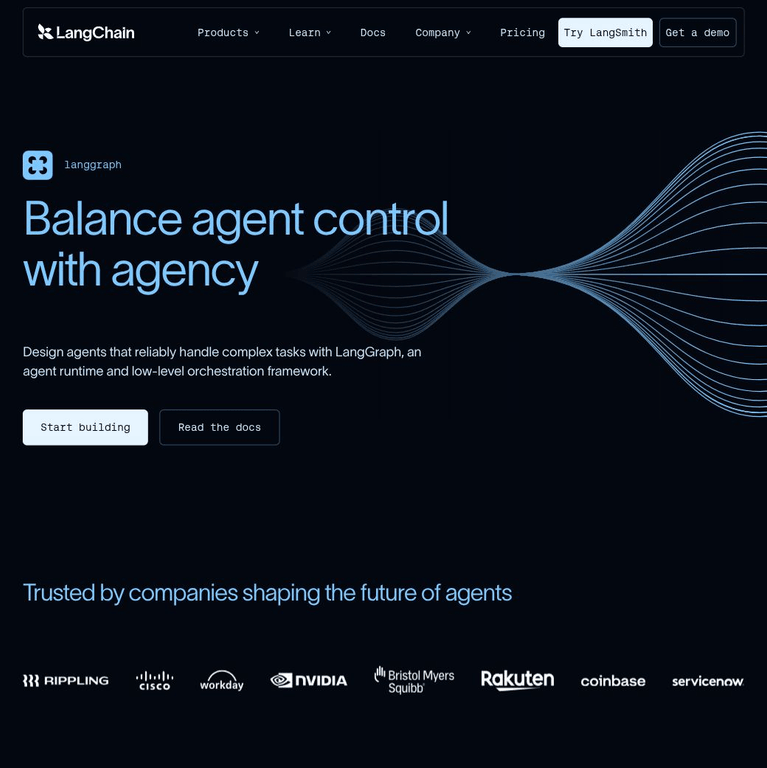
LangGraph is a low-level orchestration framework for building long-running, stateful agents as graphs. It supplies persistence, memory, streaming, human-in-the-loop control, branching, and recovery primitives so developers can control an agent’s execution instead of relying on a single opaque model call.
The Python framework is MIT-licensed and can be used independently of other LangChain products. Managed deployment, tracing, evaluation, and operational services are separate LangSmith offerings with free allowances and paid team or enterprise capacity.
Supported use cases
Build a reviewable agent
Pause before a consequential tool call and resume after a person approves or edits state.
Run a long-lived workflow
Persist progress across failures, waiting periods, or multi-step interactions.
Coordinate multiple agent roles
Represent specialized workers and routing logic as an explicit graph.
Limitations
Low-level developer framework
LangGraph requires application code, model access, tools, storage, and operational infrastructure; managed hosting and observability are separate products.
Deployment licensing differs
The MIT framework does not make every LangSmith deployment or enterprise runtime component open source.
Key capabilities
Stateful graph execution
Models agent work as nodes and transitions with explicit state.
Durable execution
Persists checkpoints so long-running workflows can pause, resume, and recover.
Human-in-the-loop control
Interrupts execution for review, approval, or state changes before continuing.
Streaming and memory
Streams intermediate events and maintains short- or long-term context through supported stores.
Related tools

A platform for building custom AI agents, workflows, and apps with connectors and models.